Higher Education Program Navigation Redesign
Creating a clear, filterable taxonomy for complex academic program offerings
The Problem
A women's college with multiple degree pathways—traditional undergraduate, fully online, weekend/evening, and low residency programs—had a confusing information architecture that made it difficult for prospective students to find relevant programs.
The existing taxonomy mixed degree types, delivery modes, and program names inconsistently, forcing users to parse through irrelevant options. This confusion created friction in the enrollment funnel and likely contributed to drop-off rates during the research phase.
The Solution
I redesigned the program finder interface with a clear, filterable taxonomy that separated three distinct dimensions: Program Type, Mode of Study, and Degree Type. This allowed prospective students to quickly narrow down options based on their specific needs—whether they were seeking evening classes, online programs, or traditional on-campus experiences.
The new structure used consistent tagging (indicated by color-coded markers) to show which programs offered which modalities at a glance, eliminating the need to click into multiple pages to understand delivery options.
My Role & Impact
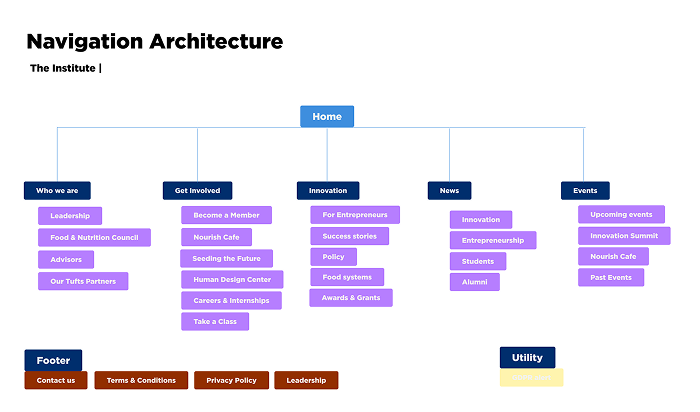
I led the information architecture strategy and content restructuring and supported design decisions with a university website redesign. I mapped the existing taxonomy, identified inconsistencies in how programs were labeled across the site, and proposed a scalable framework that could accommodate future program additions.
The redesign clarified the navigation for dozens of program combinations, making it easier for non-traditional students — a key enrollment demographic for the institution—to find weekend, evening, and online pathways that fit their schedules.
The Transformation
Before
- Mixed program names with delivery modes in single list
- No clear way to filter by schedule needs (evening, weekend, online)
- Inconsistent labeling across undergraduate and graduate programs
- Prospective students had to click into each program to understand modality
After
- Three-dimensional taxonomy: Program Type × Mode of Study × Degree Type
- Visual tagging system shows all available modalities at a glance
- Scalable structure supports adding new programs without confusion
- Non-traditional students can immediately identify schedule-friendly options
Design Principles
Programs need a clear hierarchy
The course of study needs a clear asosoication with degrees and departments
Translate the structure to design
I focused on taking some elements of the underlying structure and translating it to the design system..
Design for Non-Traditional Students
Weekend, evening, and online options needed equal visual weight to traditional programs to signal the institution's commitment to diverse learning pathways.